By: Robert Mone and Moureen Biira
Ten years later, Yumbe District has taken strong measures to restore forests that were heavily degraded by refugee-related activities.
By 2010, Yumbe District had a total land area of 2,393 square kilometers, of which 250 square kilometers were occupied by five refugee settlement zones.
The district had 63.8 thousand hectares of tree cover in 2010. By 2020, this had reduced to 58.5 thousand hectares, and by last year it had fallen further to 50.5 thousand hectares.
Out of Yumbe’s estimated population of 900,000 people, 208,180 are refugees and asylum seekers, mainly from South Sudan and the Democratic Republic of Congo. This population has significantly depleted natural tree cover by harvesting trees for construction and fuel, as well as clearing land for agriculture. Since 2016, when the Bidibidi Refugee Settlement was established covering 250 square kilometers, forest loss has contributed up to 97 percent of the decline.
According to the Global Forest Watch report, between 2001 and 2024, Yumbe District lost approximately 8,500 hectares of tree cover, leaving only 293 hectares of natural forest by 2020. The report also shows that by 2020, natural forest cover in Yumbe stood at about 25 percent.
The findings further indicate that agriculture contributed to 7,900 hectares of forest loss, settlements and infrastructure accounted for 250,000 hectares, and shifting cultivation contributed 290,000 hectares of forest loss over the last twenty years.
However, by 2020, Yumbe also gained 1,200 hectares of tree cover through restoration efforts.
Natural forest remains a critical resource for Yumbe.

Drivers of deforestation
- Permanent agriculture – 7,900 hectares
- Settlements & infrastructure – 250,000 hectares
- Shifting cultivation – 290,000 hectares
Drivers of temporary disturbances
Timothy Kisaka, Settlement commandant at Bidibidi refugee settlement in Yumbe district revealed that there is dire need to support refugees with fuel to reduce tree cutting that in long run affects vegetation cover leading to climate change.
According to Kitaka, it’s important to take a proactive approach to implement some interventions like making access to clean cook stoves to the refugee population easier alongside promotion of Agroforestry and reclaiming degraded areas to restore lost forest.
Harvesting firewood has escalated conflict between refugees and local communities’ overtime as communal hunting grounds and community grazing lands are encroached upon.
Margret Poni, 57 years old refugee woman based in Zone Two of Bidibidi Refugee settlement reveals challenges she goes through in accessing firewood as energy for cooking at home.
“When we had just come to Bidibidi in 2016, we would harvest firewood within her neighborhood within 1-Kilometres from my homestead, ” Poni said. But the challenges persisted where as I take now, I travel more than 10-Kilometres to fetch firewood in the areas of Iyete amid challenges of long distance and hostilities from the host communities.” Poni added.”
Poni had been selling part of food distributed to her to buy firewood from the local communities before cutting off the food rations and sometimes harvesting cassava stems to prepare meals for her children and relatives under her care, something which has become hard difficult to access firewood.
Emmanuel Abade, a community based focal person International Refugee Committee for Zone Three in Bidibidi Refugee Settlement said, there are cases of harassment on women as they go to community to harvest the firewood.
“There have been numerous isolated cases of women Raped, and assaulted in the bush by the host community while fetching firewood because sometimes the refugee women had not been approaching the land lords formally to request for firewood due to individual differences and language barrier” Abade narrated.
Interventions
Government and UN-agency formulated Forest landscape management plan for the Bidibidi refugee settlement between 2023–2028, was formulated to regulate interventions for the management of environmental and forest resources in the Bidibidi refugee settlement.
The plan builds on work that started in 2019 under a multi-stakeholder approach including Food and Agriculture Organization of the United Nations, the Office of the United Nations High Commissioner for Refugees, the Office of the Prime Minister, the Ministry of Water and Environment, the Yumbe District Local Government, local landlords and refugee welfare councils.
In 2021, The Republic of Uganda secured World Bank funding worth USD178.20-million to implement Investing in Forest and Protected Areas for Climate-Smart Development Project.
The six-year project is being implemented by the Ministry of Water and Environment together with Uganda Wildlife Authority and National Forestry Authority to improve the sustainable management of forests and protected areas and increase benefits to communities in target landscapes.
The Uganda “Investing in Forest and Protected Areas for Climate-Smart Development (IFPA-CD) Project is a six-year project that is being implemented by the Ministry of Water and Environment (MWE) as the lead agency together with Uganda Wildlife Authority
The project supports increase in forest cover, Tourism promotion, value addition, Increased revenues, Skilling for job creation, Livelihood improvement and Climate resilience among communities.
Investing in Forests and Protected Areas for Climate Smart Development

The Project also provided for distribution of firewood to people with special needs like the chronically sick women, Persons with Disability, elderly and child headed families, targeting 8704 Refugee households.
Margaret Athieno Mwebesa, Commissioner for Climate Change and Focal Point for the United Nations Framework Convention on Climate Change in the Ministry of Water and Environment revealed that environmental challenges were at an increase at Bidibidi Refugee Settlement.
Athieno said the Refugee Open door policy has made it possible for ever increasing refugee populations in Uganda, specifically Bidibidi.
“If you look at the satellite map, Bidibidi is one of the most degraded places in the world and urgently needs support.
The Investing in Forest and Protected Areas for Climate Smart Development Project is especially important in restoring and improving our natural resources through agroforestry, woodlot establishment, and agroforestry systems. For me, from a climate change perspective, planting trees is not enough. We must grow the trees and support them, which means strengthening the entire value chain,” Athieno stressed.
Dilemmas in restoration
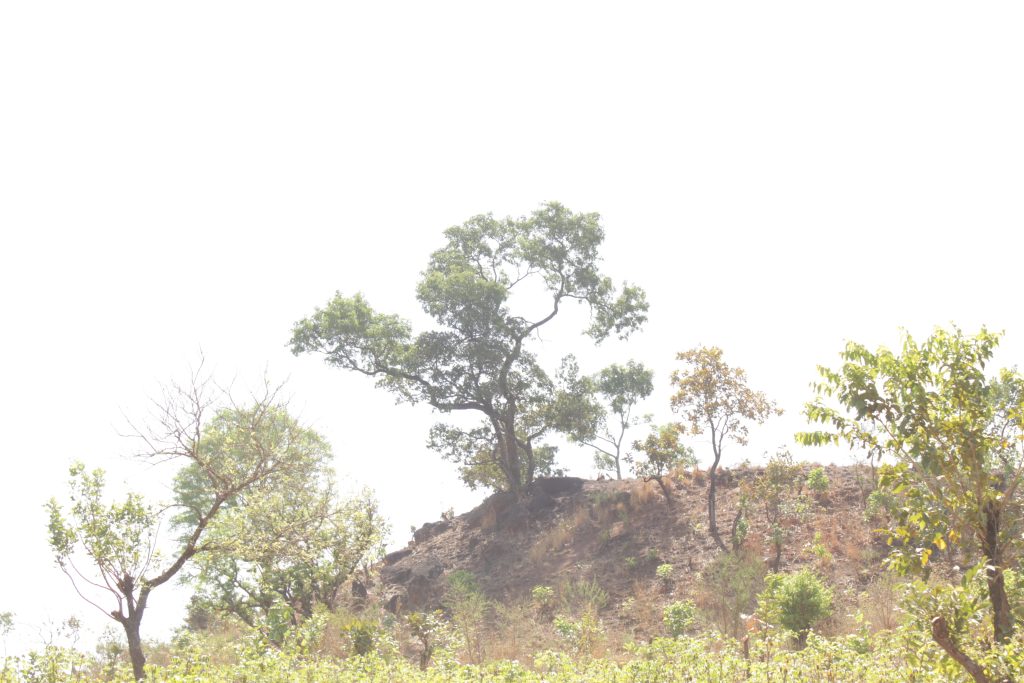
Since refugees arrived in Yumbe, forest degradation has intensified. Communities depend heavily on forest resources, using poles for construction, wood for fuel, and at least two cubic meters of firewood per household each day, as well as clearing land for agriculture.
Habib Sebbi Edema, the Yumbe District Forest Extension Officer, explained that the areas now occupied by refugee settlements were once community grazing lands with relatively good green cover. However, since the settlements were established, the district has moved into a red zone.
“What we have seen as a major challenge in restoring forests are wildfires set by local communities while hunting, stray animals that destroy planted trees, and prolonged dry spells that hinder tree survival, which is now stagnating at 45 percent,” Edema lamented.
“As a government, we had the Development Response to Displacement Impact Project that supported restoration efforts, along with partners like Dan Church Aid and Save the Children, who are helping to gradually restore the lost green cover,” Edema added.
He further revealed that restoration progress has stagnated between 45 and 50 percent instead of reaching the target of 80 percent because host communities have not fully embraced the restoration efforts..
Mile stone in forest restoration
Since 2019, the United Nations High Commissioner for Refugees have planted 4,447,119 tree seedlings, with 5,924-ha of woodlots.
This year only, the UN-Refugee agency raised 591,664 and distributed 491,469 tree seedlings by October with survival rate at 80%.
Through various Agencies, UNHCR established 158 out of 350 projected by September.
Paul Kenya UNHCR head of sub-office based in Arua overseeing Madi-Okollo, Adjumnai, Obongi, Moyo and Yumbe said West Nile hosts 484,000 refugees being hosted.

Kenya underscores Open door policy for Uganda and settlement approach that Uganda has adopted which is harnessing coexistence but calls for more interventions in Environment and climate change mitigation strategies.
On 13th November, UNHCR, the UN Refugee Agency, launched the Refugee Environmental Protection Fund, to support reforestation, cleaner cooking and green jobs that link environmental recovery with sustainable livelihoods and protection outcomes.
The Fund shall implement projects in Uganda and Rwanda for 10-years, with the ultimate goal of restoring over 100,000 hectares of land and expanding clean energy access to 1 million people.
In Uganda, Africa’s largest refugee-hosting country, the Refugee Environmental Protection Fund plans to restore around 6,000 hectares of degraded land across the Refugee settlements of Bidibidi in Yumbe and Kyangwali in Kikuube districts, by engaging local cooperatives in seedling production and forest management, and introducing cleaner household energy solutions to reduce reliance on wood fuel.
These efforts are expected to cut over 200,000 tons of Carbon oxide annually, strengthen food and water systems, and create thousands of green jobs for refugees and members of the host community.Apart from UN-Refugee Agency and Government of Uganda, other private sector players are equally supporting the initiative to restore the traditional tree spices among other is Shea Nuts and National Oils Conservation Limited (SNNOC) with the one-acre shea tree nursery in Midigo Town council in Yumbe district.
This private company is concentrating in restoration of shea trees across West Nile through football meant to increase campaigns against cutting shea trees for charcoal as well as art and craft, formation of cooperative groups to grow Shea tree and help in harvest of the seeds and currently raising seedlings 50,000 for distribution to farmers starting next rainy season

George Akuma, the General manager highlighted several interventions to enhance shea tree conservation including annual football tournament for youths across shea districts of Yumbe, Koboko and Moyo with plans to expand it to Obongi, Terego and Madi-Okollo.
“We have registered 11-Shea cooperative groups with each having minimum of 50-members, 14-satellite nurseries spread across Leforo sub county in Moyo, Binagoro, Midigo, Osubira and Awuba in Yumbe district with each raising 4,000 seedlings to supply the farmers”. Akuma explains.
Akuma cited lack of land to establish a demonstration garden for farmers to learn best practices, inadequate water supply to ensure raining the seedlings throughout the year, greenhouse to protect the seedlings from extreme weather conditions like prolonged dry spells between December and April as well as reliable transport means to support community sensitization and extension services to shea farmers.
We have registered 15-shea farmers with 25-acres land ready to plant the trees next year in various locations within west Nile, but greatly challenged with mobility, as dry season is approaching, we have fear of possibilities of Ayo swamp drying posing a big challenge to our main nursery bed since we don’t have green house to provide additional support to the seedlings. Akuma added
Yumbe district local government alone distributes 45,000-70,000 tree seedlings annually to farmers who willingly request for the trees for planting for the last 6-years.
Meaning cumulatively the district has distributed between 270,000-420,000 seedlings something that would plant between 600acres-933acres of trees in the restoration efforts.
This story was funded by ACME (African Centre For Media Excellence) in partnership with Climate Smart Jobs Uganda (CSJ)