BY INNOCENT KIIZA
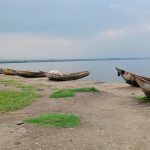
The road to Lake Katwe winds quietly through the vast savannah of Queen Elizabeth National Park. From a distance, the lake flashs under the morning sun, its white top hinting at abundance. But up close, the story is different.
Here, salt is not just a mineral. It is survival. And for the thousands who depend on it, survival is measured not in kilograms but in sacks.

A Lifetime in Salt, A Lifetime of Uncertainty
Sarah Tinditina, 52years, a mother of six children has known no other life, apart from lake Katwe.
“I was born here. I grew up here. Salt is all I have ever done,” she says, her hands hardened by years of labour. A mother, a miner, and a trader, Tinditina inherited her salt pan from her parents just as generations before her have done but with time she bought others salt pan to expand the business.
In Katwe, ownership is often passed down through bloodlines, though some miners expand by buying additional salt pans. But over time, she says, the business has become increasingly difficult.
“The weather has changed. Floods come and destroy the pans. Sometimes you invest everything, and the lake takes it back,” she explains.
Yet, beyond the climate change distress, another force has quietly eroded their earnings: the absence of standardized measurement.

Trade Without Scales
At Lake Katwe, salt is not sold by weight—at least not in any verified sense. Instead, it is traded using sacks, loosely labeled as 50 kilograms or 100 kilograms. But these measurements exist more in assumption than accuracy.
“The buyers come with their own sacks,” Tinditina says. “They fill them as they want, then decide on the price after negation with salt miners.”
In the dry season, when salt production peaks, a 50-kilogram sack may fetch as little as 10,000 Ugandan shillings (about $2.70). During the rainy season, when production drops, the same sack can rise to 20,000 shillings (about $5.40)—or even higher in distant markets.
But for miners, the fluctuation offers little advantage.“When there is plenty, we are desperate to sell. When there is little, we have nothing to sell,” she says.
Worse still, she alleges that middlemen often manipulate the very sacks used for trade.
“They bring sacks marked 50 kilograms, but when they sell, they get almost double from what they bought. It is cheating in broad daylight.” Tinditina says
The Cost of Survival
For miners like Jannet Biira, the work is not only uncertain but also expensive.
As dark clouds gather overhead, she hurries to harvest salt before the rains return. During the wet season, extraction becomes a race against time and water.
“You must hire a generator to pump out rain water,” she explains. “It costs about 10,000 shillings ($2.70) per hour. The longer it runs, the more you pay.”
To protect her salt pan, she buys wooden poles—each costing 4,000 shillings (about $1.10)—and piles up sand each in a sack to create barriers against flooding. By the time she begins harvesting, she may have invested over 1 million shillings (approximately $270).
“And then a trader comes with a sack and pays you only 20,000 shillings ($5.40),” she says quietly. “You sell because you have no choice.”
Power in Numbers—Or Lack of It
Efforts to organize miners have had mixed success.
Peter Twimamatsoiko, chairperson of the Mahonda Extractors and Traders Cooperative Society, says cooperatives were meant to protect miners from exploitation.
“We encouraged them to join so they can have one voice,” he explains. “But many did not cooperate.”
Those extracting rock salt locally commonly known as Mahonda have managed to introduce weighing scales within their group. Even then, adjustments are made: a 50-kilogram sack is often increased to 55 kilograms to account for losses during transport and drying.
Still, Twimamatsoiko acknowledges the broader problem.
“Without proper measurement, miners of grade A salt are being exploited,” he says, calling on the Uganda National Bureau of Standards to intervene.

A Business Built on Imbalance
For traders like Ronald Businge, who has spent eight years in the salt business, the system is simply market dynamics at play.
“Prices depend on supply and demand,” he says. “In the dry season, salt is plenty, so prices go down. In the rainy season, production is low, so prices go up.”
When asked about measurement, he sincerely said,“I prefer using sacks to weights,” he admits.
The explanation, he says, lies in operational costs—transport, packaging, and labor. But his preference underscores a system that largely benefits traders, not producers.

From Lake to Farm
Far from Katwe, the salt finds its way into cattle farms across western Uganda and beyond.
Mugisha Robert, a livestock farmer, depends on Katwe salt to boost milk production and improve animal appetite.
“This salt is very important for my animals,” he says. “It makes them healthy.”
He buys a 50-kilogram sack at prices ranging from 35,000 shillings ($9.50) in the dry season to as much as 60,000 shillings ($16.20) in the rainy season.
Unlike miners, Mugisha gets his salt weighed on certified scales in the market.
“We see the measurement ourselves,” he says..
A Declining Industry
Back in Katwe, the crisis runs deeper than measurement.
At the town council offices, economic planner Asiimwe Massyline points to a sharp drop in revenue. Before recurring floods, the lake generated about 50 million shillings ($13,500) monthly. Today, it barely reaches 3 million shillings (around $810).
The number of operational salt pans has fallen from 800 to just 200.
“Many miners left after their pans were destroyed,” she explains. “The cost of rebuilding is too high.”
The effects ripple through the community—children dropping out of school, families turning to risky alternatives like illegal fishing in nearby lakes.
“Salt mining was our backbone of this community,” Massyline says. “Now it is collapsing.”
Local leaders admit the gaps.
Ramadahan Ahamad Kasereka, vice chairperson of Katwe-Kabatooro Town Council, says there is no formal policy regulating measurement at the lake.
“We adopted the 50-kilogram sack as a standard,” he says. “But traders now come with oversized sacks labeled 50 kilograms.”
He acknowledges that some miners may be losing income but insists the council lacks resources to provide weighing scales but we gave mandate to the cooperative society and we are going to continue sensitizing them.
Why Measurement Matters
Daniel Arorwa, surveillance manager from the Uganda National Bureau of Standards says accurate measurement is fundamental to fair trade adding that fortified edible salt standard which is US EAS 35:2021 and to acquire this standard one requires sampling , testing methods for salt intended for human consumption.
He added that selling goods using informal systems like sacks, he warns, opens the door to exploitation and denies producers value for their work. Certified weighing scales, on the other hand, ensure transparency and protect both buyers and sellers.
Arorwa added that while Uganda has standards for edible salt, there are currently no specific regulations governing raw salt from artisanal mines like Katwe. However, efforts are underway at the East African Community level to harmonize standards for raw salt.

A Future at Risk
Lake Katwe was producing approximately 15,000 tons of crystalline salt annually through traditional mining methods. Located in Kasese, Uganda, the lake used to have over 10,000 salt pans, with high production peaks during dry seasons (January-March, July-September). While historically higher, current production is primarily artisanal. According to vice chair Kasereka, Lake Katwe produces over 250,000 tons of pure salt and more than 300,000 tons of rock salt annually. That number has now plummeted to just 400 tons.”

Today, production has dwindled drastically. “If nothing is done,” Asiimwe warns, “salt mining here could disappear.”
For Sarah Tinditina and hundreds like her, the struggle is not just about salt. It is about fairness.
“We work hard,” she says, looking over the glistening pans. “But what we get is not equal to our sweat.”
Until Lake Katwe’s salt is measured on scales instead of sacks, that imbalance may continue quietly, persistently beneath the weight of every bag sold.